Accessibility Tools

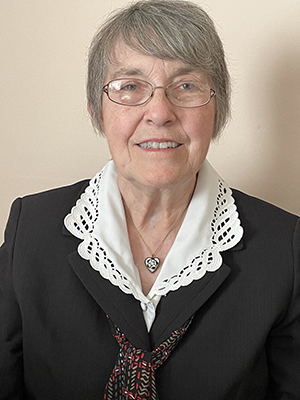
Through taking piano lessons and sitting next to her mother at church, Marcia learned to sing the alto part of hymns. In the 7 th and 8 th grade chorus, she was part of the alto section. She also was a member of the band in junior high and played alto saxophone. However, when it was time for high school, Marcia had a choice to make. Students could not participate in both chorus and band during their freshman and sophomore years. Marcia had an opportunity to be the choral accompanist and that is what she chose. There were many musical skills that Marcia learned by being the accompanist that she would use many times in her later career as a music teacher.
In addition to music, sports were an important part of her growing up. At that time, Salem Community Schools had only intramural sports for women through Girls Athletic Association of which Marcia was a member throughout high school and was recognized as Outstanding G.A.A. Girl for 1964. Marcia also participated in Tri-Hi-Y and appeared in a few theater plays in high school. During the summer of her senior year she was selected to go to Girls State at Indiana University.
Another activity that was important to Marcia during these pre-college days was 4-H. Her mother was a 4-H leader and Marcia was a member for 10 years. She was selected to give a devotional as a Junior Leader at 4-H camp as well as being a participant in the State Fair 4-H Girls School.
Upon graduating from Salem High School, Marcia entered David Lipscomb College, a Christian school, in Nashville, Tennessee, where she majored in music education with an emphasis in piano. She was a member of the Women’s Glee Club and ACappella Singers. She often accompanied the ensembles as well as serving as accompanist for voice lessons. During this time she gave a junior piano recital and a senior piano recital.
The curriculum for music education was several hours beyond what most majors require. At that time Lipscomb was on the quarter system. Most majors required 12 quarters to graduate while music majors required at least 14 quarters. Marcia finished her course work in 14 quarters. Since she finished later in the academic year, she decided to put an application in to do substitute teaching in the Metro Nashville area. However, the superintendent in Salem lefta message with her parents that there was a position for her teaching “disadvantaged” children through a title program, so she loaded up her things and headed for Salem. Her responsibilities were divided between Bradie Shrum Elementary School and Salem Jr. High School. The elementary school (K-6) had over 1,200 students and part of the 6 th grade was housed at the junior high. Mrs. Sara Minor shared classes with Marcia at the elementary school. In doing so, the time for each class period was increased. Marcia was responsible for the 6 th grade at the junior high school. She accompanied the elementary chorus and Bradie Singers in their programs and had a 6 th grade chorus at the junior high.
During the summers, Marcia worked toward her Master of Music Education degree at Indiana University that included a graduate recital and attained it in 1974. Through the years teaching in Salem, Marcia provided accompaniment for the Salem High School musical productions of Oklahoma, South Pacific, You’re a Good Man, Charlie Brown, Carnival, and The Music Man. Marcia also participated in community groups. She was a member of the Sweet Adeline Chapter and soon became its director for the 7 years she lived in Salem. She was a member of the Women’s Study Club and presented a lecture/recital program of her graduate recital. She was the Young Career Woman’s nominee for the Salem chapter of BPW in 1970. In 1974 she became a member of the Christopher Harrison Chapter of the Daughters of the American Revolution and continues that membership in the chapter receiving her 50-year pin in the summer of 2025. She was also initiated into Delta Kappa Gamma, International Society for Women Educators and continues that membership. Marcia also taught piano lessons after school at Kramer Music Store. A few of her advanced students participated in the solo-ensemble contests sponsored by the State Department of Education.
Marcia was a member of the Fort Hill Church of Christ and taught a Bible class for young women. She continues to attend worship services there when she is visiting Salem. In 1975 the Department of Music at David Lipscomb College needed an additional piano teacher to satisfy the suggestions of the Southern Association of Colleges and Universities (SACS). The chair, Mrs. Frances Hall Hill, Marcia’s former piano teacher at Lipscomb, offered Marcia the position. It was a difficult decision to make, but she accepted the offer and moved to Nashville, Tennessee, just in time to start teaching in the summer quarter. Through the 40 years of teaching at Lipscomb, she taught private piano, class piano, music history and music literature as well as elementary music methods for elementary education majors and music majors. She also supervised numerous music majors in their elementary and secondary placements in student teaching. In addition to teaching duties, she accompanied many student degree recitals and gave an occasional piano recital.
Marcia held membership in several music organizations and actively participated and held offices in Music Teachers National Association (MTNA, including the state and local chapter), National Association for Music Education (NAfME), American Orff-Schulwerk Association (AOSA), Organization of American Kodaly Educators (OAKE), International Kodaly Society (IKS), Sigma Alpha Iota (SAI). She was faculty advisor for (SAI) and NAfME. She attended national conferences and workshops available through her 40 years tenure at Lipscomb. She holds the Professional Certificate through MTNA, Level I Orff Certification through Hamline University and Kodaly Certification (all 3 levels) through Indiana University. In 1982, she took a leave of absence from Lipscomb University to enter Indiana University to pursue her Doctor of Music Education degree. She received an assistantship to teach elementary music methods for education majors. Her other areas of study included piano and music history. Her dissertation was an experimental study entitled The Effect of the Interaction of Students’ Perceptual Modality with Teaching Method on Singing Achievement in Third Graders. During this time Marcia was initiated into the Society of Pi Kappa Lambda, national honorary society for music.
Marcia continued her Bible teaching at Highland Village Church of Christ with 4’s and 5-years old and a ladies Bible class during the week.
She returned to Lipscomb in the winter of 1986 to continue her teaching. She entered the teaching assignment in 1975 as an Instructor of Music; in 1988 she attained the rank of Assistant Professor, in 1990 she was tenured, in 1994 the rank of Associate Professor, and in 1999 the rank of Professor of Music. She received her D.M.E. in 1991. Other awards include Teacher of the Year in the local chapter of MTNA in 1994; the John William Baker Summer Fellowship Award in 1999, numerous awards in the local alumnae chapter of Sigma Alpha Iota, National Advisor of the Year in Sigma Alpha Iota (2001), and Professional Fraternity Association Faculty Advisor Award of Excellence in 2008.
In 1999 Marcia was appointed chair of the Department of Music at Lipscomb. She held this position for 9 years during which she lead the department through NASM (National Association of Schools of Music) accreditation and SACS accreditation. Following her tenure she assumed the Associate Chair for Academics in the Department of Music. Marcia retired in 2016 after 40 years of service to Lipscomb University and 7 years of service to the Salem Community Schools. She continues to pursue learning through the Lifelong Learning Program at Lipscomb. Marcia is a member of the Church of Christ in Green Hills where she has taught Cradle Roll classes for several years and a ladies Bible class.
When Marcia talks with music education majors, she asks them why they are pursuing this degree. Many times it is because of the music teachers they have had. In Marcia’s own experience that is one of the reasons why she decided to become a music teacher. She had Miriam Baker, music teacher, eleven of the twelve years in the Salem system. What an influence to have the same teacher that long! Two other influencers were her piano teacher at Lipscomb, Frances Hall Hill, and the choral director, Charles Nelson. These three provided a great deal of encouragement and inspiration.
One of the things Marcia has tried to do is to be an encourager to students. In piano classes/lessons, she provides positive comments so that students can see they can pass the piano barrier if they spend the time in the practice room. She provides suggestions and feedback to student teachers to help them be more effective in their classroom experiences. For friends who are pursuing graduate degrees, she stays in touch providing encouragement through their degree program. “Cooperate and graduate,” are reminders to work hard and get the degree.
Generally speaking, a music teacher is the lone teacher in the school. Classroom teachers or teachers of a particular subject have others to confer with about their subject matter but not the music teacher or art teacher. That is the reason for finding other teachers of music and art to discuss subject matters. This can be done at workshops and conferences. These experiences are like a “shot in the arm.” One comes away with inspiration and many ideas to implement or make revisions in their own teaching.
This fund is an encouragement to the music teachers of Washington County, Indiana, to apply for funds to attend state and national conferences, summer workshops, certificate programs, and other activities that will help them in their teaching career. Marcia wants to offer an opportunity for growth in the way that she received it.


Washington County
Community Foundation
Suite 100
1707 North Shelby Street
Salem, Indiana 47167
812-883-7334
info@wccf.biz
Privacy Policy
EIN 35-1883377